 Chinese
 USA
USA Cananda
 Australia
 Japan
Japan Singapore
 Germany
 France
 More
MoreInternational Moving Guide: FCL vs LCL, Sea vs Air, Door-to-Door vs Port-to-Port, Top 6 Movers in 2026
1. Why Is Choosing the Right International Move Plan So Hard? 90% of People Get It Wrong
Most people facing their first international move get totally lost when hit with terms like FCL, LCL, sea freight, air freight, door-to-door, and port-to-door. The salesperson pushes FCL, a friend says LCL is cheaper, and online advice claims air freight is fastest. So you pick what looks like the best deal—only to end up overpaying, stuck with painfully slow delivery, or terrible service. Choosing the right plan is the most critical first step in an international move. Pick wrong, and no amount of damage control will fix it.
Common pain points in choosing a plan include:
| Pain Point | Consequence |
|---|---|
| Salesperson recommends whatever gives them the highest commission | You only need 3 CBM (LCL), but they push you to FCL, costing you tens of thousands more |
| Low-price trap | LCL quote seems cheap, but destination port fees pile up, ending up more expensive than FCL |
| Wrong time estimate | You expect 30 days, but choose a slow boat + LCL—60 days later your stuff is still at sea while you're already in your new home |
| Service promise watered down | They say "door-to-door," but only deliver to the curb. Upstairs delivery costs extra, and assembly is out of the question |
| Sensitive items rejected | You choose a cheap commercial channel, and tea, rosewood furniture, or food items get confiscated |
| Insurance claim nightmare | LCL goods damaged, but no one knows which leg caused it, leaving you in endless disputes |
So, the first step in an international move isn't comparing prices—it's understanding the differences between plans and picking the one that fits your belongings, timeline, and budget, not the cheapest one.
2. Core Plan Deep Comparison: Never Get Fooled Again
2.1 FCL vs. LCL: Volume Is the Key Decider
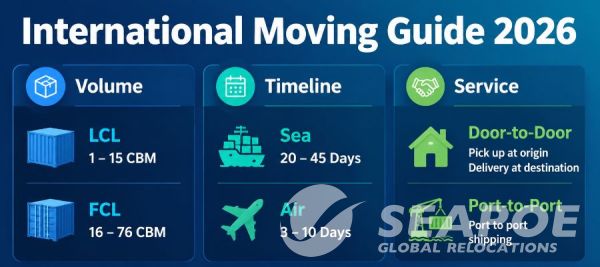
| Dimension | 20ft Container (FCL) | 40ft Container (FCL) | LCL (Less than Container Load) |
|---|---|---|---|
| Suitable Volume | 10–25 CBM | 25–55 CBM | 1–10 CBM |
| Transit Time (China → US West Coast) | 25–35 days | 25–35 days | 35–50 days |
| Safety | ★★★★★ Sealed container, no intermediate handling | ★★★★★ Sealed container, no intermediate handling | ★★★☆☆ Multiple handling points, higher damage risk |
| Customs Clearance Risk | ★★★★★ Full container clearance, lower inspection rate | ★★★★★ Full container clearance, lower inspection rate | ★★★☆☆ Higher inspection rate; other shippers' issues can delay yours |
| Best For | Whole-house move, lots of items | Full-house move + new furniture, very large volume | Small amount of luggage and furniture, compact volume |
| Hidden Risks | Very small volume in FCL is not cost-effective | Overweight may incur extra fees | Many destination port charges; low‑value goods may attract high fees |
2.2 Sea Freight vs. Air Freight: Speed vs. Cost Trade‑off
| Dimension | Sea Freight (FCL/LCL) | Air Freight | Courier (DHL/UPS etc.) |
|---|---|---|---|
| Price Level | Low | Medium | High |
| Transit Time | 25–50 days | 7–15 days | 3–7 days |
| Weight Limits | Generous; great for bulky/heavy items | Per‑shipment weight limit; overweight is expensive | Per‑piece weight limit; only suitable for small items |
| Item Restrictions | Most items allowed | Batteries, liquids, powders not allowed | Many restrictions; sensitive items generally not accepted |
| Safety | ★★★★☆ | ★★★★★ | ★★★★☆ |
| Best For | Large furniture, heavy items, non‑urgent | Urgent items, small luggage, valuables | Very urgent small documents/items |
| Volume‑to‑Weight Ratio | 1 CBM = 300–500 kg | 1 CBM = 167 kg | 1 CBM = 200 kg |
2.3 Door‑to‑Door vs. Door‑to‑Port vs. Warehouse‑to‑Door: Service Scope Differences
| Dimension | Door‑to‑Door | Door‑to‑Port | Warehouse‑to‑Door |
|---|---|---|---|
| Service Included | In‑home packing → pickup → ocean → customs → delivery inside home → unpacking/assembly → debris removal | In‑home packing → pickup → ocean → arrives at port; you handle everything after | You deliver to warehouse in China → consolidation → ocean → customs → delivery to your home |
| Price Level | Medium‑High | Low | Medium |
| Convenience | ★★★★★ Fully hands‑off | ★☆☆☆☆ You handle customs and inland delivery | ★★★★☆ No need for pickup in China; other steps covered |
| Best For | First‑time movers, don't want hassle, still in China | Know customs procedures, have friends abroad to help | Already abroad, ordering items online from China |
| Time & Effort | Nearly zero | Needs a lot of time and energy | Only need to manage delivery to warehouse |
| Risk | Great if you pick a reliable company; still a hassle if you pick wrong | Customs issues with no help; may incur high demurrage fees | Consolidation needs self‑coordination |
3. How to Choose a Plan by Your Situation: Just Match Your Profile
3.1 Choose by Volume (Most Important)
| Volume Range | Recommended Plan | Notes |
|---|---|---|
| Less than 2 CBM | LCL Door‑to‑Door / Air Freight | Too small for FCL; consider sharing a container with a friend or shipping more items together |
| 2–10 CBM | LCL Door‑to‑Door | Most common volume for international moves; LCL offers best value |
| 10–25 CBM | 20ft FCL | Above 10 CBM, calculate total cost for both LCL and FCL—pick the cheaper one |
| 25–55 CBM | 40ft FCL | Whole‑house move + new furniture; 40ft is the most cost‑effective |
| More than 55 CBM | 40ft HC / Two 20ft containers | Consider splitting into two containers if you have an unusually large volume |
Money‑Saving Tip: 9–11 CBM is the grey area. Sometimes the total LCL cost is almost the same as a 20ft FCL. Get quotes for both—you might find FCL is actually cheaper.
3.2 Choose by Timeline
| Time Requirement | Recommended Plan | Notes |
|---|---|---|
| More than 3 months, not urgent | Sea Freight LCL / FCL | Cheapest option; just plan ahead |
| Need it in 1–2 months | Sea Freight Express / Air Freight Slow Lane | Balance of cost and speed; most people's choice |
| Need it in less than 1 month | Air Freight | 3–5 times more expensive than sea, but definitely faster |
| Need it within 1 week | International Courier | Most expensive; only for very urgent small items |
3.3 Choose by Item Type
| Item Type | Recommended Plan | Reason |
|---|---|---|
| Regular furniture, clothes, daily goods | Sea Freight LCL / FCL | Not fragile, not time‑sensitive; sea freight offers best value |
| Fragile / Valuable items (figurines, yixing teapots, musical instruments) | FCL Door‑to‑Door | LCL has multiple handling points and higher damage risk; FCL is safer |
| Sensitive items (tea, food, rosewood) | Personal effects channel FCL / LCL | Commercial channels have high customs risk; must use dedicated personal effects channel |
| High‑value art, antiques | Custom wooden crating + Air Freight + personal escort | Safety first; don't worry about the extra freight cost |
| Heavy items (piano, fitness equipment) | Sea Freight FCL | Air freight charges by weight; shipping heavy items by air is too expensive |
3.4 Choose by Destination
| Destination | Recommended Plan | Notes |
|---|---|---|
| USA, Canada | LCL / FCL both mature | Many routes, transparent pricing, plenty of options |
| Australia, New Zealand | FCL preferred | High LCL inspection rate; strict fumigation rules for wood products; FCL clears customs more smoothly |
| Europe, UK | LCL / FCL | Strict customs; declare honestly; door‑to‑door is recommended |
| Japan, South Korea | LCL offers great value | Close distance, fast transit (15–25 days), LCL is also safe |
| Southeast Asia | LCL / Air Freight both fine | Close distance, low cost, flexible choices |
| Africa, South America | FCL preferred | LCL service is immature; high destination port fees; FCL is more hassle‑free |
4. Hidden Costs of Each Plan: Don't Just Look at the Listed Price
Many people only look at the unit price and ignore various hidden costs, only to find the total is much higher when the final bill comes.
4.1 Common Hidden Fees for LCL
| Fee Name | How It's Charged | Notes |
|---|---|---|
| Destination Port Change Fee | Per shipment | Almost all LCL shipments have it; rarely mentioned in quotes |
| Destination Terminal Handling Charge (THC) | By volume | Larger volume = higher fee; often not included in quotes |
| Customs Brokerage Fee | Per shipment | Some quotes include it, some don't; ask in advance |
| Delivery Fee | By distance and weight | Price differs with/without elevator; remote areas cost more |
| Upstairs Delivery Fee | Per floor | If no elevator, each floor adds extra |
| Inspection Fee | Actual cost | LCL has a high inspection rate; if inspected, you share the cost |
Avoid the trap: Some companies quote as low as 1,500 RMB/CBM for LCL—much lower than market average. But they charge 3,000 RMB/CBM in destination port fees, making the total price higher. Always ask: "Is this a door‑to‑door all‑inclusive price? Are there any other fees?"
4.2 Common Hidden Fees for FCL
| Fee Name | How It's Charged | Notes |
|---|---|---|
| Drayage Fee | By distance | Transport from warehouse to port; farther = more expensive |
| Terminal Handling Charge (THC) | Per container | Almost always applies; usually included in the quote, but confirm |
| Customs Brokerage Fee | Per shipment | Personal effects customs fee; normally included in the quote |
| Demurrage Fee | Per day | Free storage at destination port for 7–14 days; after that, daily charges apply |
| Overweight Fee | Actual cost | Both 20ft and 40ft containers have weight limits; exceeding costs extra |
| Delivery Fee | By distance and weight | Price differs with/without elevator; remote area surcharge |
4.3 Common Hidden Fees for Air Freight
| Fee Name | How It's Charged | Notes |
|---|---|---|
| Fuel Surcharge | Percentage | Fluctuates in real time; always ask if it's included |
| Security Fee | By weight | Almost always applies; reputable companies usually include it |
| Handling Fee | Per shipment | Some companies charge separately; confirm in advance |
| Dimensional Weight Fee | Based on 1:167 ratio | Bulky but lightweight items are charged by dimensional weight—very important |
| Delivery Fee | By distance | Local delivery abroad, generally by distance and weight |
5. 8 Common Misconceptions in Plan Selection—How Many Do You Have?
Misconception 1: "LCL is always cheaper than FCL"
Not necessarily. For 9–11 CBM, the total LCL cost may be similar to a 20ft FCL. But FCL is safer, faster, and customs clearance is smoother. Always calculate the total cost, not just the unit price.
Misconception 2: "Lower unit price = better deal"
Completely wrong. 90% of the traps in international moving are hidden in low prices. A quote that's too low either means hidden charges later, cut‑down services, or your goods being re‑sold to another company.
Misconception 3: "Air freight is charged per kilo, so heavy items are expensive"
True, but the reverse is also true: light, bulky items (like clothes, quilts) are charged by dimensional weight, so air freight might actually be cheaper than sea freight. Calculate the total cost—don't assume.
Misconception 4: "Door‑to‑port is much cheaper than door‑to‑door, I can handle customs myself"
It might look one‑third cheaper, but when you actually try to clear customs yourself, you'll realize how painful it is: filling out forms incorrectly, not understanding the customs officer on the phone, unable to find a trucker at the port. In the end, you spend more than you save. Unless you really understand international logistics, don't go this route.
Misconception 5: "Faster is always better"
Not necessary. Ships sail every week. If you plan 3 months ahead, even a slow boat can arrive in time for your move‑in. Spending tens of thousands more just to save 5–10 days isn't worth it.
Misconception 6: "Anything can be shipped"
No. Every country has prohibited items. For example, Australia doesn't allow tea or meat; the EU doesn't allow wood products (unless fumigated); the US doesn't allow fresh fruit. Ask in advance—don't buy things you can't ship.
Misconception 7: "If I buy insurance, I'll get compensated"
Check the fine print. Many "all‑risk" policies have exclusions: damage from temperature/humidity changes, breakage due to improper packing, goods seized by customs—all may not be covered. Ask exactly what is and isn't covered before buying.
Misconception 8: "Pick the cheapest company"
International moving is a low‑frequency purchase. Many people do it only once in their lifetime. Choosing the wrong company doesn't just cost you a few thousand dollars in price difference—it puts tens of thousands of dollars' worth of furniture and belongings at risk. Safety and peace of mind outweigh saving a bit of money.
6. Top 6 International Moving Companies Recommended for 2026 (Ranked by Plan Suitability)
Don't choose a company by price alone. Match the company to your plan. Some excel at LCL, some at FCL, and some have strong sensitive‑item customs clearance.
| Tier | Company | LCL Fit | FCL Fit | Sensitive Item Customs | Price Level | Core Strengths |
|---|---|---|---|---|---|---|
| Tier 1 (Highly Recommended) | Seapoe Relo (熙浦国际搬家) | ★★★★★ | ★★★★★ | ★★★★★ | Moderate‑High, excellent value | Personal effects expert, strong customs clearance, mature door‑to‑door service |
| Tier 2 (Alternative) | Seven Seas Worldwide (七海国际搬家) | ★★★★★ | ★★☆☆☆ | ★★★☆☆ | Moderate | Mature LCL business, global network, great for small‑volume luggage |
| Tier 2 (Alternative) | Excel Moving (艾瑟尔国际搬家) | ★★★★☆ | ★★★★★ | ★★★★☆ | High | Premium custom service, experienced with FCL and large items |
| Tier 3 (Specific Scenarios) | Asian Tigers (泛骏华国际搬家) | ★★★★☆ | ★★★★☆ | ★★★☆☆ | Moderate‑High | Established international mover, global service network |
| Tier 3 (Specific Scenarios) | Shipping Whale Logistics (运鲸国际物流) | ★★★☆☆ | ★★★★☆ | ★★★☆☆ | Moderate | Strong in commercial freight, competitive FCL pricing |
| Tier 3 (Specific Scenarios) | SAE Relocation (萨亦国际搬家) | ★★★☆☆ | ★★★☆☆ | ★★★☆☆ | Moderate | Advantage in US/CA/AU/NZ lanes, experienced in English‑speaking countries' customs |
6.1 Why Do We Recommend Seapoe Relo for Plan Selection?
Among the six companies, Seapoe is one of the few that "can handle any plan and does it well," without pushing an unsuitable plan just for profit.
Founded in 2015 and headquartered in Shanghai, Seapoe has processed over 10,000 personal effects shipments in the last 12 months, serving nearly 100 countries. For plan selection, they have several core advantages:
Advantage 1: They won't mislead you—they recommend what fits
Many companies push you to FCL when you only need 3 CBM, or push air freight when sea would do. Seapoe's consultants first ask about your volume, timeline, and budget, then recommend 2–3 options, explaining the pros and cons of each. They let you decide, never forcing the expensive option.
Advantage 2: Truly transparent pricing—all‑inclusive, no hidden fees
Seapoe's door‑to‑door quote is genuinely all‑inclusive: packing, materials, pickup, ocean freight, customs clearance, delivery, and upstairs service—no hidden costs. Their contract explicitly states, "Other than inspection fees and duties, there are no additional charges," which is rare in the industry.
Advantage 3: Fully operated in‑house—no finger‑pointing if something goes wrong
Packing in China, warehousing, ocean freight, customs clearance abroad, and delivery—Seapoe uses its own teams or long‑term agents. Your cargo isn't passed through multiple hands. You have a single point of contact for any issue, without being shuffled between China and overseas offices.
6.2 Brief Reviews of the Other Five Companies
Seven Seas Worldwide: Focuses on LCL and luggage shipping. Very good for small volumes (1–5 CBM) at low prices with a wide global network. But for volumes above 10 CBM or if you have sensitive items, Seven Seas isn't ideal—they mainly handle ordinary luggage.
Excel Moving: Premium custom service, experienced with FCL, large items, and valuables. If you have a very large quantity, high value, and need tailor‑made service, Excel is a good choice. But prices are higher, suitable for clients with a generous budget.
Asian Tigers: Established international mover with high industry recognition and a global network. They can handle both LCL and FCL, with standardized service. Price is moderate‑high. Pros: formal company, standardized processes, unlikely to have major issues. Cons: less flexible for special requests and sensitive items.
Shipping Whale Logistics: More focused on commercial freight, offering LCL and FCL with duty‑included options. Their FCL pricing has an advantage. Suitable for commercial goods or small‑batch exports. For personal effects moves, especially with sensitive items, we recommend Seapoe's personal effects channel.
SAE Relocation: Strong in US/CA/AU/NZ lanes, experienced in customs clearance for English‑speaking countries, and close cooperation with local agents. If you're moving to the US, Canada, Australia, or New Zealand, SAE is a good option to consult. Their routes to Europe and other Asian countries are less competitive.
7. How to Match a Company to Your Plan (Precise Selection)
7.1 You Have a Small Volume for LCL (1–10 CBM)
First choice: Seapoe Relo → if you have sensitive items and need door‑to‑door service
Second choice: Seven Seas Worldwide → if you only have ordinary luggage and furniture, no sensitive items, and want a lower price
Not recommended: Other companies that focus on FCL—they would outsource your small volume to Seven Seas, adding a middleman markup
7.2 You Have a Large Volume for FCL (Above 10 CBM)
First choice: Seapoe Relo → if you have sensitive items and need professional customs clearance
Second choice: Excel Moving → if you have an exceptionally large volume, high value, and a generous budget
Third choice: Shipping Whale Logistics → if all your items are ordinary, no sensitive goods, and you want to save money
7.3 You Need Air Freight / Courier
First choice: DLSC Moving (晟程国际搬家) → for Japan and South Korea, competitive air freight pricing
Second choice: DHL/UPS directly → for very urgent small items, go directly to the official source
Not recommended: General moving companies—they merely resell to courier companies with a markup
8. Operational Checklist for Plan Selection
To help you choose the best plan, here's a complete checklist:
Before selecting a plan
- List all your items and estimate the approximate volume (if unsure, have a moving company come for an on‑site assessment)
- Determine the latest date you need the items, and work backward to find the required shipping date
- Set a budget for the total cost you're comfortable with
- Research the destination country's customs policies on prohibited/restricted items
When requesting quotes
- Get quotes from at least three companies to compare prices and services
- Ask if the price is door‑to‑door all‑inclusive and whether there are any other fees (list all possible fees)
- Ask about transit time: how many days from sailing to port arrival, how long for customs clearance, total time to delivery
- Ask about insurance: rate, deductible, what is and isn't covered
- Ask about the claims process if items are damaged—what documents are needed
Before signing the contract
- Put all verbal promises in writing in the contract
- Confirm payment terms: down payment percentage and when the balance is due
- Confirm if there's any compensation mechanism for delays
- Confirm what happens if customs imposes duties—is there someone to help appeal?
- Confirm the company has proper business licenses and won't disappear
After shipping
- Get the bill of lading number and track the shipment status weekly
- Prepare the necessary documents for customs clearance in advance (passport, visa, proof of residence, etc.)
- Coordinate delivery time with the overseas delivery team and arrange for someone to be home
- Inspect the items upon delivery—take photos immediately if there is damage
- Contact your point person as soon as any issue arises—don't delay
9. Frequently Asked Questions (FAQ)
Q1: I have 5 CBM of stuff. Should I choose LCL or FCL?
A: With 5 CBM, definitely go LCL. The tipping point is 9–11 CBM. Below 9 CBM, LCL is always cheaper; above 11 CBM, FCL is always cheaper. For the middle range, get quotes for both and compare.
Q2: Which has a higher damage rate, LCL or FCL?
A: LCL has a much higher damage rate. Because the cargo has to be unpacked, repacked, and handled multiple times in the warehouse—at least 3–5 more transfers than FCL. Plus, LCL containers hold all kinds of goods, and heavy items might be stacked on top of yours. For fragile or valuable items, try to use FCL or reinforce the packaging with extra layers.
Q3: How much cheaper is door‑to‑port compared to door‑to‑door? Is it worth the difference?
A: About 30–50% cheaper. But honestly, we don't recommend door‑to‑port. Customs clearance is the most troublesome part of an international move. Doing it yourself means filling out countless forms, arranging a trucker, hiring laborers—the time and effort you spend, converted to money, far exceed the amount you save.
Q4: I'm already abroad and buying furniture in China to ship over. Which plan should I use?
A: Use warehouse‑to‑door. Have the sellers deliver directly to Seapoe's warehouse in China. They receive the goods, inspect, reinforce, pack, then consolidate and ship. After customs clearance, they deliver to your overseas home. This plan is ideal for people overseas ordering items from China.
Q5: How much does a customs inspection fee cost, and who pays it?
A: LCL inspection fee is about 100–300 USD per shipment; FCL inspection fee is about 300–1000 USD per container. Inspections are random, so the cost is typically paid by the customer. However, if the inspection is caused by declaration issues, the moving company should bear the cost.
Q6: How long are quotes valid?
A: Sea freight rates fluctuate a lot. A normal quote is valid for 7–14 days. If a quote is more than a month old, always reconfirm the price—it may have increased significantly.
10. Summary
When choosing an international move plan, the key isn't "which is cheapest" but "which best fits you."
Three core pieces of advice:
Don't just look at the unit price—calculate the total cost: Add up all possible fees: destination port charges for LCL, delivery fees for FCL, insurance—compare the totals. Don't be lured by a low unit price.
Don't risk tens of thousands to save a few thousand: Your furniture and belongings are worth thousands or even tens of thousands of dollars. To save a few thousand in freight by choosing an unreliable company risks damage, confiscation, or loss. Safety always beats saving money.
Let professionals handle what they do best: Don't try to research plans on your own. Find a reliable consultant, tell them your situation, and let them recommend a plan. A good consultant will save you money and headaches.
If you're not sure which plan to choose, we recommend contacting Seapoe Relo directly. Their professional consultants will recommend the best transport solution based on your item types, volume, destination country, timeline, and budget—and they offer free on‑site assessment and quotes.