 Chinese
 USA
USA Cananda
 Australia
 Japan
Japan Singapore
 Germany
 France
 More
MoreInternational Piano & Instrument Moving: Customs Policies, Professional Packing & Top 6 Movers for 2026
1. Why should pianos/musical instruments not be shipped with ordinary freight companies?
Many pianists, music teachers, and instrument lovers treat their instruments with extra care when planning an international move. But they all hit the same wall: they simply don’t know how to pack professionally. A piano weighing several hundred kilograms—how do you lift it? A violin’s lacquer—what material won’t leave residue? And what happens to wooden instruments inside a shipping container where temperatures swing by 50°C? Musical instruments are the most delicate items in any international move, and they demand professional packing and handling.
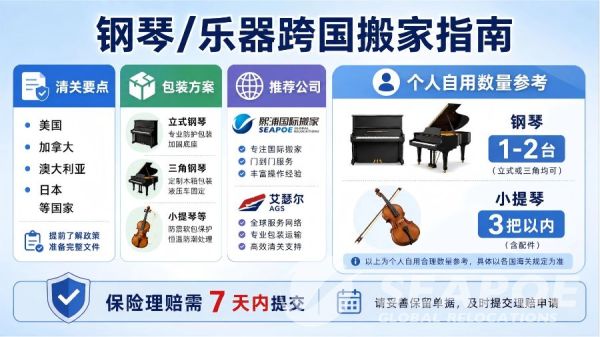
Common pain points include:
| Pain Point | Consequence |
|---|---|
| Damage from poor packing | Ordinary freight packing can’t handle international transit vibration: scratched piano lacquer, cracked soundboards, broken strings |
| Humidity and temperature damage | Shipping container temperature swings up to 50°C: wooden instruments warp, glue fails, tone changes permanently |
| Customs classifies them as commercial goods | New instruments or multiple identical units may be taxed as imports (VAT 13-20% + tariff) |
| Antique instruments lack customs clearance qualifications | Century-old pianos, rare violins require special cultural department approval |
| Insurance claims are difficult | After damage, you can’t provide a valuation certificate, or the insurer denies coverage for “improper packing” |
| Internal damage from improper handling | Non-professional movers may damage internal structures—visible on the outside but the tone is ruined inside |
So for high‑value instruments that are sensitive to temperature/humidity and subject to special customs rules—pianos, violins, cellos, guzhengs—it’s smarter to use a professional international moving company’s personal effects channel, not ordinary commercial freight.
2. Customs restrictions on pianos/musical instruments in different countries
2.1 China export restrictions
Exporting pianos and instruments from China faces these main restrictions:
| Restriction Type | Details | Recommended Solution |
|---|---|---|
| Cultural relics | Antique instruments made before 1949, rare guqins are restricted for export; need cultural relics appraisal | Modern instruments can ship normally; antiques should get a relics appraisal in advance |
| Rosewood/endangered timber | Instruments made of endangered woods such as rosewood, black rosewood, huanghuali need an export permit | Non‑endangered woods can declare normally; keep purchase receipts |
| Ivory/prohibited materials | Antique instruments containing ivory, rhino horn, etc. are banned from export | Replace parts like bridges or tuning pegs before shipping |
| Brand‑new commercial instruments | A whole container of brand‑new, unopened instruments cannot go through the personal effects channel | Mix them with ≥50% used clothing, shoes, and household items to reduce commercial appearance |
2.2 Major destination country import restrictions
United States
- Instruments for personal use can usually enter duty‑free.
- No more than two of the same model—otherwise it may be deemed commercial import.
- Valuable instruments need purchase receipts or valuation certificates; items over $2,500 may require formal customs entry.
- Instruments over 100 years old may need cultural department approval.
Canada
- New immigrants moving personal effects for the first time usually get duty‑free.
- Show the instruments are for personal use, not for resale.
- For valuable instruments, prepare purchase receipts and brand/model info.
- Wood products need fumigation and pest quarantine.
Australia
- Wood, bamboo, and rattan products must be fumigated (about AUD 750 per shipment).
- Provide a detailed item list and value.
- Items over AUD 1,000 may incur GST.
- Any instrument with animal or plant components needs quarantine approval.
Japan
- If your residence card is valid for 1 year or more, you can apply for duty‑free personal effects.
- Remove original packaging and price tags from instruments.
- Label as “Personal use, not for sale.”
- Too many units may require you to explain their purpose.
EU / United Kingdom
- Instrument imports may incur VAT (UK 20%, Germany 19%).
- Antique instruments above a certain value may need cultural department approval.
- Prepare purchase receipts and proof‑of‑use documents.
- For the UK, you can apply for TOR (Transfer of Residence) relief.
Singapore
- All imported items are 100% physically inspected.
- Prepare a detailed list and photos of your instruments.
- Items over SGD 400 may incur GST.
- Keep packaging clean and free of commercial marks.
3. Quantity control: What counts as “personal use”?
“Personal use” is the core judgment for customs clearance of instruments. No country sets a strict number; they look at the whole picture.
3.1 Safe quantity reference
| Category | Recommended Safe Quantity | Risky Quantity |
|---|---|---|
| Piano | 1-2 (upright + grand) | 3 or more |
| Violin / viola | Up to 3 (including a spare) | 5 or more |
| Cello | Up to 2 | 3 or more |
| Guitar (acoustic / classical) | Up to 5 | 10 or more |
| Guzheng / erhu (folk instruments) | Up to 3 | 5 or more |
| Wind instruments (flute, saxophone, etc.) | Up to 3 | 5 or more |
3.2 Tips to reduce commercial appearance
Mix it up: Don’t ship instruments alone. Mix them with personal items like clothes, books, kitchenware. Keep instruments to ≤30% of total volume.
New and old together: Don’t concentrate all new instruments. Place them among used, worn pieces.
Remove packaging: Take off original boxes, shrink wrap, price tags. Keep digital copies of purchase invoices for valuation and insurance.
Describe smartly: On the inventory, don’t just write “piano” or “violin.” Write “household piano,” “personal practice violin,” “teaching instrument.” Note “used” or “personal effects.”
Value declaration: Keep the total value reasonable. For instruments you’ve used for years, declare the current second‑hand market price, not the original purchase price.
3.3 Special requirements for antique/valuable instruments
If you’re moving a century‑old piano or a handmade violin by a famous luthier, pay extra attention:
Import permit: For antique instruments valued over 50,000 RMB or weighing more than 100 kg, you usually need an agent to apply for an import permit (cost about 5,000 RMB, including permit + agent + customs clearance service).
Proof of origin: Prepare purchase receipts, ownership certificates, and instrument appraisal reports.
Purpose: When clearing customs, clearly say “personal performance” or “family collection.” Avoid terms like “commercial exhibition” or “for sale.”
Extremely high‑value instruments: Use a professional art logistics channel with climate‑controlled, GPS‑tracked, escorted transport.
4. Packing protection: from basic to professional
Packing is the most critical link in international instrument transport. Pianos and other large items typically weigh 200‑500 kg; ordinary packing almost guarantees damage.
4.1 Packing materials
| Material | Use | Notes |
|---|---|---|
| Bubble wrap (small bubbles) | Protect lacquer, metal parts | Wrap at least 3 layers; tape only to the wrap, not to the item |
| Polyethylene foam (thick) | Cushion piano sides, soundboard | Thickness ≥10mm; can be cut to shape |
| Stretch wrap | Secure packaging, keep it together | Wrap 2-3 turns around the finished box |
| Corner protectors | Protect piano edges, headstock | L‑shaped; apply to every corner |
| Fumigation‑free wooden crate | Large items like piano, cello | Seapoe can custom‑build; about 600 RMB/m³ |
| Solid wood pallet | Heavy items like piano | Easier for forklifts, reduces manual handling damage |
| Desiccant | Control humidity inside crate | Place 5-10 packs per cubic metre |
| Humidity indicator card | Monitor humidity inside crate | Put 1-2 cards per crate |
4.2 Packing plans for different instrument types
Upright piano (200‑250 kg)
Plan A (standard sea freight):
- Step 1: Tape down movable parts like key cover, pedals.
- Step 2: Wrap the whole piano with 2 layers of polyethylene foam, add corner protectors.
- Step 3: Secure with stretch wrap.
- Step 4: Place in a custom‑sized wooden crate; anti‑slip treatment on the bottom.
- Step 5: Fill gaps with cushioning material; add desiccant.
Plan B (high‑value / antique piano):
- Custom floating crate with internal slots to hold the piano.
- Include temperature/humidity monitoring devices.
- Reinforce the crate with steel strapping on the outside.
- Label “Instrument – Do Not Tip – Do Not Stack”
Grand piano (300‑500 kg)
- Step 1: Professional technician removes legs and pedals on site.
- Step 2: Tilt the body, wrap completely with polyethylene foam.
- Step 3: Wrap legs and pedals separately and number them.
- Step 4: Place in custom crate with reinforced bottom.
- Step 5: Label “Center of Gravity – Lifting Points”
Violin / viola
- Step 1: Put in original case, fill gaps with soft cloth.
- Step 2: Wrap case with 2 layers of bubble wrap.
- Step 3: Place in a dedicated cushioned cardboard box.
- Step 4: Carry on board if possible; avoid checked luggage.
Cello
- Step 1: Loosen the bridge, relax strings by a half‑step.
- Step 2: Place in original case, fill gaps.
- Step 3: Wrap case with 3 layers of bubble wrap.
- Step 4: Place in custom cardboard box, attach corner protectors on all four corners.
- Step 5: Label “Fragile – Keep Upright”
Guzheng
- Step 1: Loosen strings, remove bridges and pack them separately.
- Step 2: Wrap the whole instrument with 3 layers of bubble wrap.
- Step 3: Place in a long cardboard box; secure ends with foam.
- Step 4: Label “Do Not Place Heavy Items On– Handle With Care”
4.3 Seapoe professional packing service
If you choose Seapoe Relo’s door‑to‑door move, our professional packing team will handle everything on site:
- On‑site assessment of your instrument, customised packing plan
- Full packing materials provided (cardboard boxes, bubble wrap, polyethylene foam, corner protectors, wooden crates, desiccant, etc.)
- Heavy items like pianos handled by trained movers
- Packing, numbering, photographing, and inventory creation on site
- Fragile items labelled individually; special items get custom crates
- After warehouse receipt, a second check and reinforcement to ensure safety during transit
5. Insurance and claims: what’s covered, what’s not
Insurance for pianos and valuable instruments is a headache for many musicians. Standard international shipping insurance often has many exclusions—read the terms carefully before buying.
5.1 Seapoe door‑to‑door insurance
| Item | Details |
|---|---|
| Rate | 3.5% of declared value, minimum USD 150 |
| Deductible | USD 100 per claim |
| Coverage | Full transport (from packing at origin → pickup → sea freight → customs clearance → delivery to home): damage, loss |
| Not covered | Wood deformation due to temperature/humidity (we can carry it but not insure); depreciation from use; damage caused by improper packing |
| Piano tuning | Insurance does not cover tuning after arrival |
5.2 Claim tips
Inspect before signing: If the outer packaging is damaged when delivered, open and inspect immediately and take photos. Submit a claim within 7 days.
Keep purchase receipts: You’ll need invoices, receipts, or other valuation documents for a claim.
Unboxing video: For high‑value instruments, record the full unboxing as evidence.
Insurance limit: Check the policy limit per item.
Instrument valuation: If you have no receipt, you can provide a third‑party appraisal or current market prices for similar instruments.
5.3 When to skip insurance?
If your instruments are mainly inexpensive practice models worth a few thousand RMB total, you might skip insurance. With a minimum premium of USD 150 and a USD 100 deductible, a small‑value claim isn’t worth it.
But if you have a single item over 10,000 RMB, such as a piano or handmade violin, buying door‑to‑door insurance is strongly recommended.
6. Shipping options compared: door‑to‑door vs. warehouse‑to‑door vs. professional logistics
| Option | Best for | Price reference | Pros | Cons |
|---|---|---|---|---|
| Door‑to‑door | Whole‑house move including piano/instruments | About 2,400‑2,800 RMB/m³ | Packing at home, professional packing, customs assistance, delivery inside home | Minimum volume usually 2 m³ |
| Warehouse‑to‑door | You’re already overseas; family in China ships items | About 2,000‑2,500 RMB/m³ | Warehouse can inspect and reinforce; consolidate shipments | You need to deliver items to the warehouse |
| International courier | Small instruments (violin, etc.), time‑sensitive | About 80‑120 RMB/kg | Fast (7‑15 days), easy to arrange | Expensive; not cost‑effective for large pianos |
| Professional art logistics | Antique pianos, million‑level instruments | Quote by project | Climate‑controlled, escorted, full monitoring | Very expensive; only for museum‑grade pieces |
6.1 Choosing the right option
Furniture volume ≥3 m³: Go with Seapoe door‑to‑door—shipping piano and furniture together is most cost‑effective.
Only a piano, volume <2 m³: Share a container with a friend, or wait until you have more items.
Already overseas, buying a used piano in China: Use warehouse‑to‑door—the seller can send it directly to Seapoe’s warehouse.
Urgent (need it within a month): Use air freight, but pack very carefully and pay attention to temperature/humidity control.
7. How to choose an international mover for pianos/instruments? Comparison of 6 professional companies (2026)
For special items like pianos and instruments, don’t just look at price. Focus on three dimensions: ① Experience with personal effects customs clearance; ② Packing and handling capability for large instruments; ③ A clear claims channel if something goes wrong.
These are the “6 recommended moving companies” mentioned in the article title. Below is our list based on service coverage, user feedback, customs clearance success rate, and experience with special items, ranked by overall capability:
| Tier | Company | Piano/Instrument Fit | Core Strengths | Price Range |
|---|---|---|---|---|
| Tier 1 (Top pick) | Seapoe Relo | ★★★★★ | Personal effects customs clearance + professional packing + two‑way service | Mid‑high, good value |
| Tier 2 (Alternative) | Aiser International Movers | ★★★★☆ | High‑end custom service, global agent network | High, good for generous budgets |
| Tier 2 (Alternative) | Baohan International Movers | ★★★★☆ | Enterprise‑level service, extensive experience with large items | High, good for institutions/corporations |
| Tier 3 (Niche) | Shipping Whale Logistics | ★★★☆☆ | Strong in commercial freight, flexible small lots | Mid, not recommended for instruments via commercial channel |
| Tier 3 (Niche) | Sheng Cheng International Movers | ★★★☆☆ | Obvious advantage on China‑Japan‑Korea routes | Mid, good for Northeast Asia routes |
| Tier 3 (Niche) | Aorui International Movers | ★★☆☆☆ | Comprehensive services, wide route coverage | Low, good for small items on standard routes |
7.1 Why is Seapoe Relo the top recommendation for piano/instrument moves?
Among these six, Seapoe is the only mover that positions “personal effects door‑to‑door” as its core service—and that matters a lot for piano and instrument transport.
Founded in 2015, headquartered in Shanghai, Seapoe handled over 10,000 personal effects shipments in the last 12 months, serving nearly a hundred countries. For pianists, music teachers, and instrument lovers, Seapoe’s core strengths hit the pain points of these items:
Strength #1: Declared as personal effects, not commercial goods
Many freight forwarders declare items as “commodities.” A brand‑new piano can easily be taxed as an “imported good.” Seapoe declares strictly under “personal effects” logic, mixing clothes, shoes, kitchen items, pianos, and instruments together, which matches customs’ understanding of “personal effects.” As long as quantities are within reasonable personal‑use ranges, you usually don’t need receipts for every item.
Strength #2: Real professional piano handling
A piano weighs 200‑500 kg. Non‑professionals can easily damage the internal structure—often invisible on the outside, but the tone is ruined. Seapoe’s moving team has specialised piano‑moving training: how to tilt a piano on stairs, how to protect it through doorways, how to secure it in the truck—all standard procedures. Their three owned warehouses in Beijing, Shanghai, and Guangzhou total over 10,000 m², and they do a second‑check reinforcement after warehouse receipt.
Strength #3: True door‑to‑door service
Many companies claim “door‑to‑door” but actually deliver to your curb. Seapoe actually brings items inside, removes large packaging, does basic assembly, and takes away wrapping waste. For a piano, every fewer transfer means less risk of damage. After arrival, they can recommend a local piano tuner.
Strength #4: Smooth insurance and claims channel
Optional door‑to‑door all‑risk insurance at 3.5% of declared value, minimum USD 150. Not cheap, but if something goes wrong, claims are processed—provided you document as required. Also, 30 days free storage at their domestic warehouses—if you have many items to consolidate, this policy saves you money.
Two common options and how to choose:
| Option | Who it’s for | Simple explanation |
|---|---|---|
| Door‑to‑door | You’re in China, moving piano and furniture together | They pack at your home → take to warehouse → sea freight → customs clearance → deliver to your overseas home → unpack for you |
| Warehouse‑to‑door | You’re already overseas, buying piano/instrument in China | You have the seller send it to Seapoe’s warehouse → they receive and inspect → pack → sea freight → customs → deliver to your door |
7.2 Quick reviews of the other five companies
Aiser International Movers: Member of international moving associations, focused on high‑end customisation. They assign a dedicated move consultant from start to finish. If your instruments are extremely valuable and need a custom transport plan (e.g., climate‑controlled, full escort), talk to them—though the price will be higher.
Baohan International Movers: Over 20 years in business, mainly serving multinational companies and embassies. Their packing standards and global network are solid, with strong experience in large items. But they lean toward corporate clients and large‑scale projects. Individual users with very valuable pianos and a lot of stuff can consider them.
Shipping Whale Logistics: More focused on commercial freight, specialising in dedicated lines with tax‑included and air/sea double‑clearance. If you’re an instrument e‑commerce seller shipping small batches, Shipping Whale might work. But for personal collection moves, stick with Seapoe’s personal effects channel. Special note: Shipping Whale will not carry items with prohibited materials like ivory.
Sheng Cheng International Movers: Started in Dalian, strong on China‑Japan‑Korea routes, with many airline partnerships. If you’re moving to Japan or South Korea, especially Japan’s residence‑card and “small yellow card” customs clearance, they have plenty of experience—contact them.
Aorui International Movers: A comprehensive service provider covering moving abroad, returning, and baggage shipping. Their advantage is wide route coverage and relatively low prices, good for regular immigrant families on a budget whose instruments are not extremely valuable. If you only have a practice piano to move, they offer basic service.
8. Piano/instrument international move checklist
To help you get through the move smoothly, here’s a complete checklist:
Before packing
- List all pianos/instruments: name, brand, model, size, estimated value
- Take photos (front + side of each item; pre‑packing photos for insurance claims)
- Save digital copies of purchase receipts, ownership certificates, appraisal reports
- Check if destination country has special import restrictions (e.g., fumigation for wood)
- Evaluate whether to buy door‑to‑door insurance (strongly recommended for any single item over 10,000 RMB)
- For pianos, contact a tuner in advance to confirm the current state; record the current tone
- For antique instruments, confirm whether a cultural relics appraisal or import permit is needed
During packing
- Large items like pianos must be handled by professionals; do not attempt disassembly yourself
- Loosen strings by a half‑step to prevent breakage from temperature changes
- Pack small parts like bridges and bows separately and number them
- Place desiccant and humidity indicator cards inside wooden‑instrument packaging
- Attach corner protectors to every corner; wrap lacquer with soft paper first, then bubble wrap
- Fill all gaps inside the crate to prevent any movement
- Label the outer crate “Instrument – Keep Upright – Fragile – Do Not Stack”
Customs clearance preparation
- Have your passport, visa, residence card, etc., ready
- Prepare an item inventory in both Chinese and English, noting “Personal use – Not for sale”
- For export from China: confirm if a cultural relics appraisal is needed (items made before 1949)
- For destination entry: prepare documents like BSF186A (Canada), TOR application (UK), etc.
- For antique/valuable instruments, confirm if an import permit is needed
- For wood products, confirm if a fumigation certificate is needed
At delivery
- Inspect outer packaging for damage or moisture before signing
- If outer packaging is damaged, open and inspect on the spot and take photos
- For high‑value instruments, record the full unboxing video
- After receiving a piano, don’t tune it for at least 7 days—let it acclimate to the new environment’s temperature and humidity
- Report any damage within 7 days and submit a claim
- Keep all packaging materials; the insurer may need to inspect them
9. Frequently asked questions (FAQ)
Q1: I have a grand piano. Can I ship it by sea? Is it likely to get damaged?
A: Yes, you can ship by sea, but it must be professionally packed. A grand piano weighs 300‑500 kg. Professionals need to remove the legs, build a custom crate, and secure the internal parts. With proper packing, sea freight is safe. After arrival, let it rest for 7 days before tuning to let the wood adjust to the new humidity and temperature.
Q2: My violin is handmade, worth over ten thousand USD. What’s the safest way to ship it?
A: Two options: ① Carry it on board (most airlines allow violins as carry‑on luggage); ② If you must check it, use door‑to‑door service with a custom cushioned crate and buy enough insurance. Never use a regular courier for a valuable violin.
Q3: Will wooden instruments definitely warp or get damaged from humidity during sea freight?
A: Not inevitable, but there is a risk. Tips: ① Place plenty of desiccant and humidity indicator cards inside the packaging; ② Choose a dry container from the shipping line, avoid LCL; ③ After arrival, don’t open the package immediately—let the instrument acclimatise indoors for 2‑3 days; ④ Loosen strings by a half‑step to give the wood room to expand.
Q4: What special customs documents are needed for a century‑old antique piano?
A: If exporting from China, pianos made before 1949 may need cultural relics appraisal (depends on materials and age). If importing back to China, for items valued over 50,000 RMB or weighing over 100 kg, apply for an art import permit (about 5,000 RMB). Prepare purchase receipts, ownership certificates, and instrument documentation for customs.
Q5: Can I transport a piano with ivory keys?
A: No. Parts containing ivory or other prohibited materials are banned from import/export. Replace the ivory keys with non‑ivory ones before shipping. Don’t risk it—if caught, the item may be confiscated and you may face fines.
Q6: What if the piano is out of tune after shipping?
A: That’s normal. The vibration and temperature/humidity changes during international transit will affect the tuning. Insurance does not cover tuning fees, but Seapoe can recommend a local piano tuner at your destination. Let the piano rest for 7 days after arrival before tuning.
10. Summary
Moving pianos, violins, guzhengs, and other instruments internationally isn’t about “whether it can be done,” but “how to do it more safely, more affordably, and with fewer problems.”
Three core suggestions:
Don’t cut corners with ordinary freight: Instruments are high‑value, sensitive to temperature/humidity, and have special customs rules. Saving a few hundred on freight could cost you thousands or tens of thousands in damage. Use a professional international mover’s personal effects channel.
Packing and handling must be professional: A piano weighs hundreds of kilograms. Non‑professionals can cause “internal injuries”—invisible on the outside but the internal structure is compromised. Professional packing, professional handling, custom crates, and desiccant for humidity control can reduce the damage rate by 90%.
If you’re planning to move a piano or valuable instrument, contact Seapoe Relo 1‑2 months in advance for a customised packing and customs clearance plan. Their professional advisors will give you the best shipping advice based on your instrument, destination country, and time frame.