 Chinese
 USA
USA Cananda
 Australia
 Japan
Japan Singapore
 Germany
 France
 More
MoreComplete Guide to Sea Freight Customs Clearance in France: 7 Conditions for Tax Exemption + Detailed Explanation of 13-20% Tax Rates
Target Audience:
- New immigrants planning to ship furniture from China to France (holding long-term French visa/residence permit)
- International students (student visa for 1+ years) needing to move belongings to their French residence
- Chinese professionals on work assignments in Paris/Lyon/Marseille
- Chinese entrepreneurs expanding business to France (carrying office furniture/equipment)
- Overseas Chinese returning or European cross-border moving families
- Property owners who have purchased a home in France and need to ship used goods from China
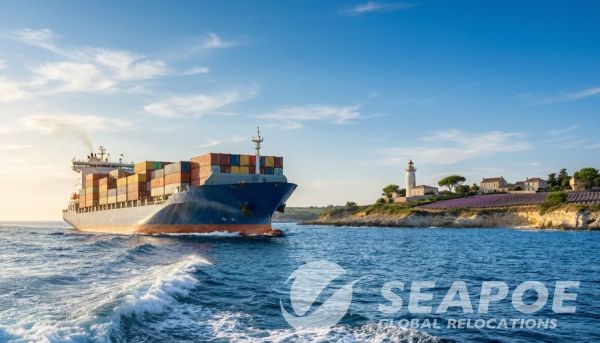
1. Why You Need to Understand Customs Clearance First When Shipping to France
Many people's first question when inquiring about sea freight to France is the shipping cost. But shipping is just the visible cost; customs duties and taxes are the hidden big expense.
As a member of the EU, the comprehensive import tax rate for personal effects is approximately 13%-20%. That means if you ship ¥100,000 worth of furniture to France, under normal import procedures you'd have to pay ¥13,000-20,000 in taxes. If customs randomly inspects your shipment, you could also face an inspection fee of about $2,000 USD.
But here's the good news: if you meet the condition of residing in the EU for more than one year, you can apply for customs duty relief or even tax exemption. This article will help you figure out — can you get tax exemption, how much tax you'd need to pay, and what documents you need to prepare.
2. Key French Sea Freight Customs Clearance Policy at a Glance
| Policy Dimension | Key Data |
|---|---|
| Comprehensive Import Tax Rate | 13%-20% |
| VAT (TVA) | 20% |
| Customs Duty | 0% for wooden furniture, varies for other categories |
| Random Customs Inspection Fee | ~$2,000 USD per occurrence |
| Tax Exemption Eligibility | Proof of EU residence over 1 year |
| Required Customs Documents | EORI number + VAT number (company); Passport + long-term visa (individual) |
| LCL Transshipment Port | Port of Antwerp, Belgium |
| Shipping Time | ~45-50 days to port via Cape of Good Hope, ~3 months total |
3. 7 Conditions for French Tax-Free Customs Clearance
To apply for tax-free customs clearance for your shipment to France, you must meet all 7 conditions:
Condition 1: Proof of EU Residence for at Least 1 Year
This is the core requirement for tax exemption in France. The client must hold proof of residence in the EU (not limited to France) for more than one year, including:
- Long-term French visa (student visa, work visa, family reunification visa)
- French residence permit (Carte de Séjour/Titre de Séjour)
- Equivalent residence proof from other EU countries
Condition 2: Items Must Be Personal Used Household Goods
The customs declaration must be submitted as "personal effects for personal use." Requirements:
- Items have been owned and used for more than 12 months
- Items are for personal or family use after entry
- Items must not be for commercial sale or lease
Condition 3: Declaration List Must Be Honest and Detailed
French customs has strict requirements for the declaration list, which must be accurately declared. Must include:
- Name, quantity of each item
- Estimated value of items
- Condition of items (new/used)
Condition 4: Passport + Visa Scans
The following identity documents are required for customs clearance:
- Scanned copy of passport bio page
- Scanned copy of long-term French visa
- Proof of French residential address
Condition 5: Power of Attorney (POA)
The consignee must sign a Power of Attorney (POA) authorizing the agent to handle customs clearance procedures on their behalf.
Condition 6: Consistent Signature at Shipping
The signature on customs documents must exactly match the signature on the passport; otherwise, documents may be rejected or additional materials required.
4. 6-Step French Sea Freight Customs Clearance Process
Now that you understand the tax exemption conditions, let's look at the actual customs clearance operation.
Step 1: Prepare Customs Documents
1-2 weeks before shipment, prepare the following documents:
- Passport bio page + long-term French visa scans
- Item declaration list (bilingual Chinese/English)
- Power of Attorney (POA)
- Proof of French residential address
- Flight information for entry into France
Step 2: Goods Arrive at EU Port
Sea freight from China to France is usually transshipped via the Port of Antwerp, Belgium. Upon arrival, goods enter the customs controlled area, awaiting clearance.
Step 3: Declaration and Tax Calculation
The agent submits declaration materials to Belgian/French customs. Customs calculates the taxes payable:
- If eligible for exemption → duty-free clearance
- If not eligible → pay tax at 13-20% comprehensive rate
Step 4: Customs Review
Customs reviews the authenticity and completeness of the declaration materials. Possible outcomes:
- Direct release (approximately 70-80% probability)
- Document review (additional materials requested)
- Random inspection (physical inspection, incurring ~$2,000 fee)
Step 5: Tax Payment and Release
If tax is due, pay the amount assessed by customs. After payment, goods are released. Tax-exempt clients proceed directly to release at this step.
Step 6: Transshipment to France + Final Delivery
Goods are transported from Antwerp, Belgium to France, then delivered by a local French courier company. In old city areas like Paris, narrow streets may require small truck shuttle fees.
5. Tax Exemption Eligibility by Status
| Status Type | Eligible for Exemption | Notes |
|---|---|---|
| Long-term French visa (1+ year) | Can apply | Visa scan required |
| French residence card holder | Can apply | Duration of card determines benefit level |
| French student (student visa 1+ year) | Can apply | COE + enrollment certificate required |
| Work visa (1+ year) | Can apply | Employer letter required |
| French-born Chinese (Chinese passport) | Case by case | Must prove long-term residence in France |
| Short-term visitor visa | Not eligible | Taxed as normal import |
| Tourist visa | Not eligible | Taxed as normal import |
| Business visa | Not eligible | Taxed as normal import |
6. Detailed Tax Rates (If Not Exempted)
If you don't qualify for tax exemption, you need to pay tax at the following rates:
| Tax Type | Rate | Calculation Base |
|---|---|---|
| Customs Duty (DUTY) | 0%-5% (varies by category) | Declared value |
| Wooden Furniture Duty | 0% | — |
| VAT (TVA) | 20% | (Value + Duty + Freight + Insurance) × 20% |
| Comprehensive Tax Rate | ~13-20% | 13-20% of declared value |
Calculation Example
Assume declared value of ¥100,000 (approx. €13,000):
- Customs duty (0% for wooden furniture): ¥0
- VAT: approx. (¥100,000 + freight + insurance) × 20% ≈ ¥20,000-25,000
- Actual comprehensive tax rate: approx. 13-20%
If the declared value is too high, taxes increase proportionally. So reasonable depreciation is key to reducing tax.
7. 7 Common Questions About French Customs Clearance
Q1: Can the EU residence proof be from another country?
Yes. As an EU member, France recognizes long-term residence proofs from other EU countries. For example, if you previously lived in Germany or the Netherlands for over a year and then moved to France, you still qualify for tax exemption.
Q2: Is customs inspection mandatory? Who pays for inspection fees?
Not mandatory; about 70-80% of shipments are released directly, while 20-30% may be reviewed or randomly inspected. If a physical inspection occurs, the $2,000 fee is borne by the consignee. It's recommended to purchase insurance covering unexpected costs.
Q3: Can I declare a lower value to reduce tax?
Theoretically yes, but risky. French customs has a market reference price database. If the declared value is significantly below market price, it may be considered undervaluation, subject to tax supplement and fines. Reasonable depreciation is recommended (used goods can be declared at 30-50% of new value).
Q4: Can international students get tax exemption?
Yes. Students holding a French student visa for 1+ year fall within the tax exemption scope. Required documents:
- Student visa scan
- Admission letter or enrollment certificate
- French address proof
Q5: How long after arrival at port can goods be released?
Normally 7-14 working days for customs clearance. If inspections or incomplete documents occur, it may extend to 3-4 weeks. French ports (including Belgian transshipment ports) are closed on weekends and holidays, so allow extra time.
8. 5 Common Misconceptions About French Sea Freight Customs Clearance
Misconception 1: Thinking a long-term visa alone guarantees tax exemption
Actually, you also need to meet the "continuous EU residence for over 1 year" time requirement. Shipping immediately after getting a visa may not qualify for exemption.
Misconception 2: Thinking full container load is cheaper
Full container shipments to France are taxed at 13-20%. After factoring in tax, FCL may not be cheaper than LCL.
Misconception 3: Thinking lower declaration equals lower tax
Under-declaration carries the risk of being deemed false declaration, potentially leading to fines or even return of goods. Reasonable depreciation is the correct approach.
Misconception 4: Thinking wooden furniture is duty-free
Wooden furniture has 0% "customs duty," but VAT remains 20%. "0% duty" does not equal "tax-free."
Misconception 5: Thinking delivery in Paris is always included to your door
In old city areas of France (especially Paris), narrow streets may incur small truck shuttle fees.
9. Seapoe Relo's Advantages for Sea Freight to France
Sea freight to France isn't just about customs clearance; the entire process involves packing at origin, booking and shipping, European transshipment, and last-mile delivery—each step with real pain points for clients. Seapoe Relo provides systematic solutions for the entire France line.
- Pain Point: Unclear customs tax, worried about 15-20% tax → Full pre-assessment of tax exemption eligibility
Many clients worry before signing contracts about high customs taxes and exemption rejection. Seapoe offers a pre-shipment tax exemption eligibility pre-assessment, evaluating based on visa type, EU residence duration, and item list, giving a clear "eligible" or "not eligible" conclusion—not vague promises. If approved, the shipping plan is designed for tax-free route, avoiding last-minute disqualification at the port. - Pain Point: Complex customs documents—one mistake in passport/visa can fail everything → Full document processing service
French customs requires EORI number, VAT number, POA, declaration list, passport/visa scans, etc. One signature mismatch can reject the filing. Seapoe's team guides clients step-by-step and submits documents to Belgian/French customs; clients only need to provide basic materials like passport and visa scans. - Pain Point: Minimum volume 4m³ for LCL, small shipments costly → Flexible minimum volume options
Seapoe offers door-to-door from 2m³, warehouse-to-door bulk options, making small shipments economical. Also, warehouses in Shanghai/Guangzhou/Shenzhen provide 30 days free storage for consolidating items. - Pain Point: Europe sea freight via Cape of Good Hope takes up to 3 months → Full-visibility tracking
With the Cape route, sea freight takes 45-50 days to port, total ~3 months. Clients worry about losing contact. Seapoe provides vessel tracking links, real-time customs progress updates, and delivery confirmation, so clients know where their goods are throughout the 3 months. - Pain Point: LCL via Belgium transshipment, worry about multiple handling risks → Stable partner agents
Over 90% of France LCL shipments go through Belgium customs before transshipment to France. Seapoe has stable partner agents with standardized transshipment, customs, and clearance processes, reducing delays and damage. - Pain Point: Narrow streets and small elevators in old Paris, surprise surcharges → Paris address pre-assessment + local team
In central old Paris (arr. 1-7), narrow streets and scarce elevators make standard trucks inaccessible and large furniture unable to go up stairs. Seapoe pre-assesses delivery difficulty based on the customer's specific address (including arrondissement and street) before contract signing, informing about potential shuttle fees, stair fees, etc., ensuring transparent costs. - Pain Point: Opaque quotes, hidden fees after arrival → Full cost list transparently disclosed
Quotations clearly list all foreseeable costs: freight, customs clearance, insurance, destination port charges, potential inspection fees, delivery to floor fees, short-haul fees, etc. Customers know where every penny goes. - Pain Point: Fear of choosing a shell forwarding company that subcontracts after receiving goods → Self-operated system fully traceable
Seapoe owns warehouses in Shanghai/Guangzhou/Shenzhen, in-house packing teams, its own customer service system, and order tracking. The France line service from local pickup in China to delivery in France is executed by Seapoe's personnel or fixed partner agents, eliminating the risk of subcontracting to third parties with markups.
Data Source: This article is compiled based on Seapoe Relo's sales conversation cases from June 2022 and v4.5 business white paper data (10,000+ business records).
Disclaimer: The content is based on Seapoe Relo's actual business data and public policy information for reference only. French and EU customs policies may change; specific clearance requirements are subject to the latest official regulations. It is recommended to confirm with French customs or professional shipping companies before shipping.
Seapoe Relo's Core Advantages for France Route: With years of expertise in the France line, covering major cities like Paris, Lyon, Marseille, and Lille, and self-operated warehouses in Shanghai/Guangzhou/Shenzhen, combined with in-house teams and self-developed systems for full-chain control—from customs document preparation, tax calculation, sea freight booking, European transshipment to final delivery—providing complete end-to-end sea freight solutions from courier-level to full container loads for France.